
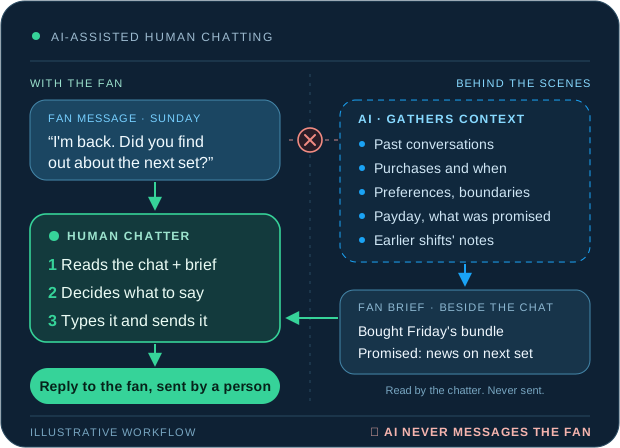
A fan spent on Friday night: a bundle, a tip, and a promise from the chatter that he'd hear about the next set by Sunday. On Sunday at 11pm he's back. The chatter on shift wasn't working on Friday and has never spoken to him.
Before she types anything, she opens the conversation. Beside it is a short brief: what he bought on Friday, what he enjoys, what he doesn't want, the answer he was promised and the note the last shift left. She reads his latest messages, checks the next agreed step on the price ladder and decides what to say. Then she types it and sends it.
AI-assisted human chatting means AI prepares the context and a person has the conversation. At Zinely, AI works behind the scenes in our own custom tools. It gathers each fan's history and turns it into a short brief beside the chat. Every message a fan receives is sent by a human chatter who has read the conversation and decided what to say. AI never chats with your fans.
This guide is for creators, agencies and AI-model operators on OnlyFans, Fanvue and Fansly who already bring in traffic and are comparing chatting options. If you're still deciding between a human team and an AI reply tool, start with our comparison of human chatters and AI chatbots. This guide answers the next question: what a human team should do with AI when the AI isn't the one talking.
What AI does, and what people do
AI's job: the context
Read back through the account's history for each fan. Pull out what matters: past conversations, purchases and when they happened, preferences, boundaries, payday, what was promised and notes from earlier shifts. Put it in a brief a chatter can read in moments.
The chatter's job: the conversation
Read the thread and the brief. Decide whether this is a moment to chat, to follow up on a promise or to make an offer. Write the message in the account's voice and send it. Own what was said.
The line between the two is simple: AI never writes, drafts or sends a message to a fan. It has no conversation with anyone. Its work ends where the chatter's decision begins.
| Part of the work | Who does it |
|---|---|
| Gathering history, purchases, preferences, boundaries and shift notes | AI, behind the scenes |
| Turning a long chat history into a short fan brief | AI, behind the scenes |
| Reading the conversation before replying | The human chatter |
| Deciding what to say, and whether to make an offer | The human chatter |
| Writing and sending every message | The human chatter |
| Prices and offers | An agreed price ladder, applied by the chatter |
| Reviewing conversations and handling exceptions | Team leads, with AI flagging chats that need a lead's attention |
Human chatters cover the inbox 24/7 across shifts, and coverage is monitored around the clock. The tools don't replace anyone on that rota. They make each person on it better informed.
Why every new shift risks a cold start
Most chatting problems that fans notice aren't about writing. They're about memory. A fan meets a chatter who doesn't know him yet, or a new shift picks up an inbox mid-conversation. The result is a cold start:
- Repeated questions.
The fan is asked what he likes, where he's from or what he's into, again. He told the account last week.
- Repeat PPV offers.
He's offered the set he bought on Friday, or the same set at a different price from a different shift.
- Forgotten details and promises.
Nobody remembers that he gets paid on the 1st, that a certain topic is off-limits, or that someone said they'd come back to him on Sunday.
A careful chatter can avoid all three by scrolling the full history before every reply. In practice, that means hundreds of messages for each fan, across a busy shift with many fans waiting. That's where details slip, however good the person is.
Zinely keeps shared fan notes in our custom CRM so context survives a change of shift. AI makes that context faster to gather and quicker to read. It turns a long history into the few lines a chatter needs right now.
That's our approach, not a claim that every chatbot fails or that a human team always earns more. Traffic, content and offers matter as much as who is in the inbox. What the approach does is give each chatter the information a good conversation depends on.
What a chatter sees at the start of a shift
A chatter starting a shift doesn't begin with an unsorted inbox. They see which fans matter right now and what each one is about: someone who spent recently and has just come back, someone whose payday is today, someone still waiting on an answer they were promised.
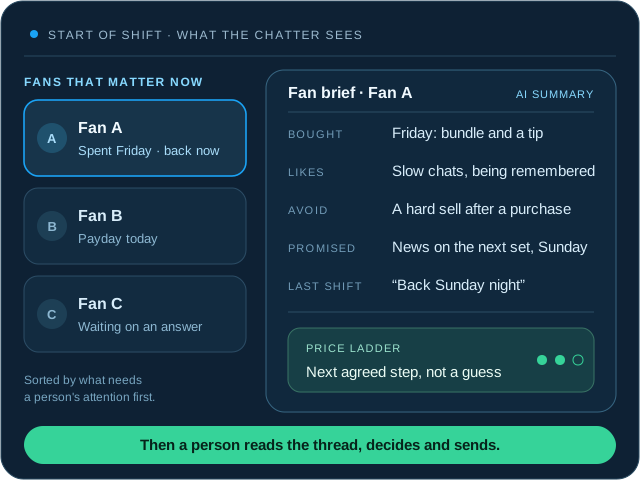
The fan brief
Each brief sits beside the conversation. It covers what the fan has bought and when, what they've said they enjoy, their boundaries, their payday if they've shared it, anything that was promised, and notes from earlier shifts. It records what the fan actually said, not guesses about their life.
The price ladder
Prices and offers come from a price ladder agreed with you, the creator or account owner. The chatter can see where a fan is on it. So a fan isn't offered the same set twice, or at a different price from a different shift.
A starting point, not a script
The brief tells the chatter where things stand. It doesn't tell them what to type. They still read the latest messages, because the conversation is the source of truth. If the fan's mood has changed, or he's asking about something the brief doesn't cover, the person adapts.
How conversations are reviewed and fan data is handled
Team leads review conversations. AI flags chats that need a lead's attention, so a lead can look at the right conversation sooner. A lead still makes the decision. Anything risky gets escalated to a team leader before anyone acts.
Fan context is handled with the same care as the account itself:
- Fan context is used to serve the account it came from.
- Notes record what fans have shared in the conversation, not speculation.
- Passwords and financial account details never go in fan notes.
- Requests outside the agreed brief go back to you for a decision.
You keep ownership of your account and its content. Account access is agreed during onboarding, and no credentials are needed for an initial estimate.
An AI-generated model is not the same as AI chatting
Operators who run AI-generated models on Fanvue often assume the inbox has to be automated too. It doesn't. The persona's images and character can be AI-generated while every conversation is handled by a person.
Zinely's human chatters run the persona from your character guide: the voice, the backstory, the boundaries and the approved offers. AI context keeps the persona's details consistent across shifts. If the persona told a fan about a weekend plan on Tuesday, the chatter on Thursday knows about it too.
Keep the disclosure the platform requires. Fanvue's guidance on AI content asks for clear disclosure of AI-generated content (source checked October 10, 2026). Chatters must never contradict that disclosure, and choosing human chatters doesn't change how the persona was made.
For the service itself, see human Fanvue chatting for AI models and creators. To prepare the character guide and handover, use our Fanvue persona brief and handover checklist.
Questions to ask any chatting agency about AI
“We use AI” can mean almost anything, from summarising notes to sending messages automatically. Ask for specific answers, and compare what each agency actually does.
- Does AI ever send a message to a fan?
Ask whether any message, including mass messages and follow-ups, can go out without a person deciding to send it. Zinely's answer: no. Every message is sent by a human chatter.
- Who reads the conversation before a reply goes out?
Ask whether a person reads the thread, or only a summary. At Zinely, the chatter reads the conversation and the brief, then decides.
- What context does the chatter see when a fan comes back?
Purchases, preferences, boundaries, promises and earlier shift notes should be in front of the chatter, not buried in a long scroll.
- Where do prices and offers come from?
Look for an agreed price ladder rather than prices invented in the moment, so offers stay consistent across shifts.
- How is quality reviewed?
Ask who reviews conversations, how problem chats are found, and who handles an exception or a risky situation.
- How is fan information stored and used?
Ask what goes into notes, what stays out, and how access ends if you stop working together.
For reference, Zinely's published chatting commission is 16.5–25% for OnlyFans and Fansly, and usually 20–25% for Fanvue, of net tips and PPV our chatters close. We don't commission subscriptions or renewals, and there are no retainers, minimums or lock-in. Platform fees still apply; final terms are agreed before launch. See pricing and our services.
Direct answers about AI and human chatting
Does Zinely use AI to chat with fans?
No. AI never chats with your fans. Zinely uses AI behind the scenes to gather each fan's context into a short brief for the chatter. Every message a fan receives is sent by a human chatter who has read the conversation and decided what to say.
Is Zinely an AI chatting tool?
No. Zinely is a human chatting agency for OnlyFans, Fanvue and Fansly. We build and use our own tools for our team; we don't sell chatting software, and our chatters are people.
Does AI write or draft the replies?
No. AI prepares context: purchases, preferences, boundaries, promises and earlier shift notes. The chatter writes each message in the account's voice and sends it.
Will fans notice when a different chatter is on shift?
We can't promise that no fan ever notices a change. The aim is that fans don't have to repeat themselves and aren't offered something they already bought, because the chatter on shift starts with their context.
Do you chat for AI models on Fanvue?
Yes. Our human chatters run the persona from your character guide, and AI context keeps its details consistent across shifts. You keep the AI-content disclosure Fanvue requires and remain responsible for the account and its content.
Who is this for?
Creators, agencies and AI-model operators who already bring in traffic and want a human team to handle conversations, follow-ups and PPV sales 24/7. Chatting doesn't replace acquisition; if few fans are arriving, start there.
Written by the Zinely team. Fanvue source checked October 10, 2026. Scenarios and illustrations are illustrative; commercial terms are Zinely's published offer.