
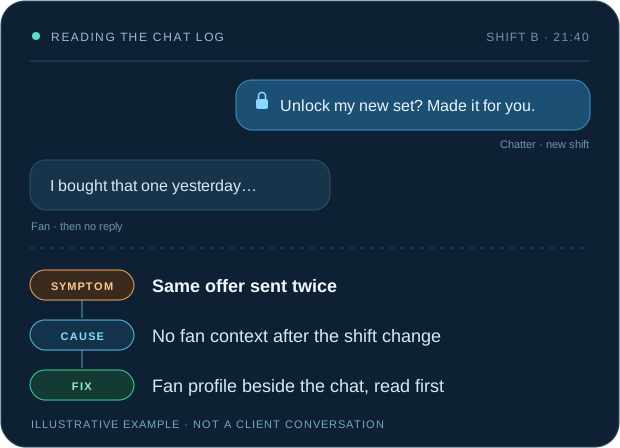
A fan unlocks a set on Tuesday. On Wednesday night a different chatter sends him the same set with the same opener. He replies, “I already bought this,” and stops answering.
Chatters usually underperform because of the system around them, not because they aren't trying. The most common causes are missing fan context at the start of each shift, scripted or badly timed selling, no approved prices, weak handovers, unmonitored gaps in coverage and nobody reviewing the conversations. Each one leaves a visible trace in your chat logs, so that is where the diagnosis starts, not in the weekly revenue total.
This guide is for creators, agency owners and AI-model operators whose current chatters, in-house or at another agency, are not delivering. For each cause you get the symptom, the reason and the fix. Then there is a ten-conversation audit you can run this week and a way to decide whether to repair the team or hand the work over. We run a human chatting agency, so we explain where our approach fits. The diagnosis works whoever does the chatting.
Rule out traffic and content before blaming the chatters
Falling revenue is not automatically a chatting problem. If fewer new fans arrive, there are fewer conversations to work with. If the vault has nothing new, chatters keep offering the same few things. Chatting cannot replace missing traffic or weak content, and a new team will not change that either.
Probably the account when…
Few new fans subscribe or message. The inbox stays quiet even when replies are fast. There is little new content to offer. Revenue dropped when a promotion or traffic source ended.
Probably the chatting when…
Fans write in but wait hours for a reply. They buy once and go quiet. They complain about repeats or pushy messages. Results swing by shift or by chatter while traffic stays steady.
Write down what else changed in the same period: traffic campaigns, content releases and price changes. Then open the conversations. Revenue tells you that something changed; the chat log tells you what.
Your chatters don't know the fan, or the creator
Context is the first thing to check. A chatter who doesn't know who they're talking to can only fall back on generic messages, and fans notice.
No fan context, so every shift starts cold
In the log: the same PPV offered twice. Questions the fan already answered (“where are you from?” for the third time). A promise such as “I'll send it Friday” that nobody keeps.
Why it happens: what the team knows about a fan lives in one chatter's head or a spreadsheet nobody opens mid-shift. The platform thread shows messages, not the story: what the fan bought, what they turned down, what they were promised.
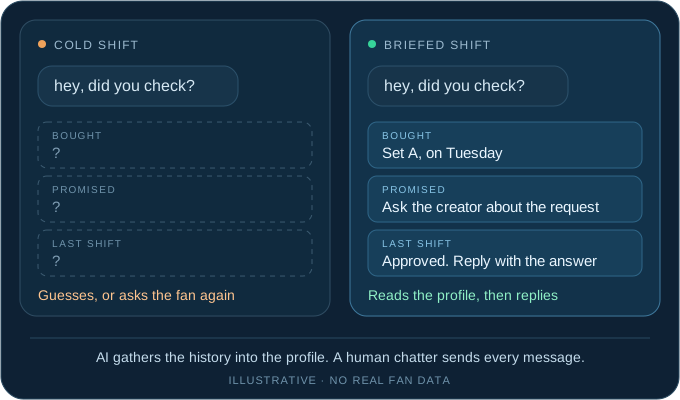
The fix: keep a fan profile next to the conversation with purchases, preferences, boundaries, open promises and the last shift's note. Make reading it the first step before every reply, especially the first reply after a shift change.
Handovers that say “all good”
In the log: conversations go cold right at a shift change. A new chatter opens with a generic message in the middle of a negotiation. Fans in another time zone get a fresh introduction from someone new every day.
Why it happens: the handover is a quick “nothing major” or a pasted chat dump, and nobody owns the open items.
The fix: for each open conversation, record what happened, what is still open and the next action with a time. Agree a fixed changeover time so two people are not replying to the same fan.
One chatter, too many inboxes
In the log: details from another account slip in (the wrong city, the wrong content, the wrong pet name). Replies get shorter and slower at busy hours.
Why it happens: the workload is set by headcount, not by how many conversations each account actually generates.
The fix: size each chatter's load by inbox volume, keep each account's brief open while working it, and plan extra cover for the busiest hours.
Voice, persona and language don't match
In the log: messages that don't sound like the creator: wrong length, wrong emoji habits, wrong slang. Offers that cross boundaries the creator set. On AI-model accounts, details that contradict the persona's backstory. Stiff, translated-sounding phrasing and missed jokes.
Why it happens: the voice and boundaries were explained once on a call and never written down, or the chatters don't share the audience's main language.
The fix: a short written brief with voice examples, words to avoid, boundaries and persona facts. For AI models, keep the required AI disclosure intact; our Fanvue persona brief has a template. Match chatters to the language the fans actually write in.
The selling is scripted, early or guessed
Low PPV sales are not always about chatters “not selling hard enough.” Often the offers arrive at the wrong moment, read like a broadcast or carry a price somebody made up on the spot.
Copy-paste scripts in one-to-one chats
In the log: identical openers sent word for word to many fans. Replies that ignore what the fan just said. Mass-message tone (“new content just dropped, babe”) inside a personal conversation.
Why it happens: scripts were taught as the job rather than as a reference. They are fast to send and easy to count.
The fix: keep scripts for structure, such as how to introduce an offer or follow up after a no, not for wording. Each reply should pick up something from the conversation. Mass messages and personal follow-ups both have a place; keep them distinct.
PPV too early, or never at all
In the log: a locked message within the first few lines of a brand-new conversation. Or the opposite: long, friendly chats that never reach an offer, even when the fan asks, “do you have anything else?”
Why it happens: pressure for quick sales on one side, fear of seeming pushy on the other, and nobody showing chatters what a natural moment looks like.
The fix: tie offers to moments in the conversation: the fan shows interest, asks about content, or comes back when they said they would. Teach what to do after a no as well as when to ask. Track repeat purchases, not just first unlocks.
No price ladder, so chatters guess
In the log: the same content priced differently for different fans, for no visible reason. Discounts offered before the fan objected. “Half price?” after a single “too expensive.”
Why it happens: there is no approved list of offers and prices, so chatters improvise to close.
The fix: write down the approved offers from entry level to premium, when a discount is allowed and by how much, and which requests need the creator's approval. Remove expired offers so nobody sells something that no longer exists.
The gaps nobody is watching
Some failures don't show up in any single conversation. They show up in the pattern: when fans wait, which mistakes repeat, and what the pay structure quietly rewards.
Slow or missing replies between shifts
In the log: fan messages that sit for hours before the first reply, clustered at the same times each day: shift changes, breaks, weekends, the creator's night.
Why it happens: the schedule has holes, and nobody notices because nobody monitors whether anyone is active on the account.
The fix: compare message timestamps with the schedule and close the gaps. Monitor activity so an empty shift is flagged within the shift, not discovered in next week's revenue.
No one reads the conversations
In the log: the same mistakes for weeks: the same weak openers, the same early discounts, the same missed follow-ups.
Why it happens: management looks at totals. Nobody reads the chats, so nobody corrects the habits behind the totals.
The fix: a lead reads a sample of each chatter's conversations every week and gives feedback tied to specific messages. Prioritise the chats that need attention: complaints, refused offers, a big spender who went quiet, a fan asking about cancelling.
Incentives that reward the wrong thing
In the log: on hourly-only pay, long idle stretches and minimal follow-up from chatters who are online but not selling. On pure commission pressure, hard pushes, discounting to close and fans burned for one quick sale.
Why it happens: people do what the pay structure rewards.
The fix: reward sales and the quality of the relationship together. Review conversation quality alongside the numbers and pay attention to repeat buyers, not just this week's unlocks.
Audit ten conversations from last week
You don't need a consultant to find the problem. Pull ten conversations from last week: three from your biggest spenders, three from new fans, two from fans who went quiet and two at random. Read each one in full and answer these questions.
- Was anyone offered something they had already bought?
Check every PPV against the fan's purchase history. A repeat points to missing fan context.
- Did a chatter ask something the fan had already answered?
Name, location, preferences, payday. Repeated questions point to missing notes or a weak handover.
- Was a promise made, and was it kept?
“I'll send it later,” “talk Friday,” “let me check with her.” Follow each one to see whether anybody did.
- How long did the fan wait at the slowest point?
Look at timestamps around shift changes, overnight and at weekends.
- Do the openers look the same across fans?
Paste them side by side. Word-for-word repeats mean scripts are doing the talking.
- When did the first offer come, and what was the fan doing at that moment?
An offer that answers the fan's interest is different from one sent into a cold “hi.”
- Do prices and discounts match what you approved?
If you never approved any, that is the finding.
- Does it sound like the creator or persona, in the fan's language?
Read a few replies aloud. Check them against the boundaries the creator set.
- Did anyone besides the chatter ever look at this conversation?
If no lead or manager has read it, nobody will catch the problems above.
Fix it in-house or hand it over
Fix it in-house when…
The failures sit with one or two people. Someone on your side has time to write the brief and the price list, read conversations every week and cover schedule gaps. Your team already keeps fan notes that people actually use.
Hand it over when…
The failures repeat across chatters and shifts. You are the one checking the inbox at 3 a.m. You don't want to build fan records, review, scheduling and coverage monitoring yourself, or you have already tried.
For the full cost and control comparison, read hiring chatters vs using a chatting agency.
How Zinely handles these failures
Fan context. We built our own tools for this. AI pulls each fan's history together, including past conversations, purchases, preferences, boundaries, what was promised and notes from earlier shifts, into a fan profile beside the chat. The chatter reads it before replying, so they know who they're talking to, including right after a shift change.
Humans chat. AI helps our chatters; it never talks to your fans. Every message a fan receives is sent by a human chatter who has read the conversation. How AI-assisted human chatting works explains the split in more detail.
Review and coverage. Team leads review conversations, and AI flags the chats that need a lead's attention, so review is not limited to whatever a manager happens to open. Coverage is monitored around the clock; if no one is active on an account, it is flagged to management.
Offers. Prices, boundaries and approved offers are agreed with you before launch. Requests outside them go to you.
Terms. Commission applies to the net tips and PPV our chatters close: 16.5–25% for OnlyFans and Fansly, usually 20–25% for Fanvue, with final terms agreed before launch. We don't commission subscriptions or renewals, and there are no retainers, minimums or lock-in. Invoices go out every two weeks. Onboarding usually happens within 24 hours of first contact, depending on account readiness and agreed access. See pricing for the full basis.
Agencies can outsource chatting under their own brand and keep the creator relationship and marketing. Fanvue operators can read about human chatting for AI models.
One honest limit: if few fans are arriving, or there's little content to offer, a new chatting team won't fix that. A useful estimate should tell you so.
Questions about fixing a chatting team
Are my chatters bad, or is my traffic too low?
Look at how many fans write in, then at what happens to those conversations. If few fans message the account, the problem starts before the chatters. If fans write but wait, get repeated offers or go quiet after one purchase, the chatting needs work.
Should I replace my chatters or retrain them?
Run the ten-conversation audit first. If one chatter fails where the others pass, retraining or replacing that person may be enough. If the same failures appear across chatters and shifts, the system is the problem, and new people will run into the same gaps.
Why do my chatters keep offering fans content they already bought?
Usually because there is no purchase record the chatter reads before making an offer, or it lives somewhere nobody opens during a shift. Put purchases next to the conversation and make checking them part of every offer.
Can a new team take over without losing fan history?
The conversation history stays on the account. Before a switch, collect any notes your current team can share and agree a changeover time so two teams are not replying at once. At Zinely, the handover and our fan profiles carry that history forward so the first shift does not start cold.
Does Zinely use AI to chat with fans?
No. AI helps our chatters; it never talks to your fans. It pulls each fan's history into a profile beside the chat and flags conversations that need a team lead. Every message a fan receives is sent by a human chatter who has read the conversation.
Will switching chatting teams guarantee more revenue?
No team can promise that. Traffic, content and pricing all affect results, and better chatting cannot replace an audience that is not arriving. Record a baseline before any change so you can see what the new team actually did.
Written by the Zinely team. Chat examples are illustrative, not client conversations. Commercial terms are Zinely's published offer.